CORSIA Eligible Fuels: SAF, LCAF and the Sustainability Criteria
What qualifies as a CORSIA Eligible Fuel, the sustainability criteria a fuel must meet, the certification and chain-of-custody requirements, and why burning sustainable fuel without the paperwork produces no CORSIA claim.
Qualifying fuel reduces a CORSIA offsetting requirement directly. But CORSIA Eligible Fuel is a defined term with hard criteria, and fuel that is genuinely sustainable in every ordinary sense can fail to qualify on documentation alone.
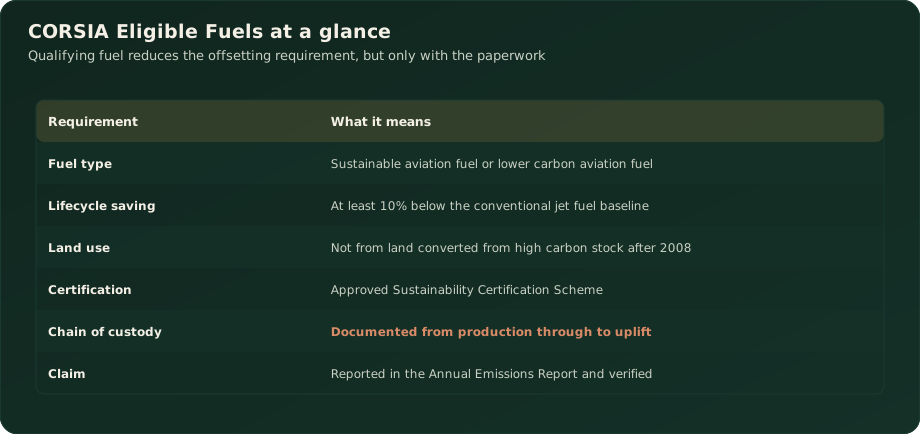
Two Categories
CORSIA Eligible Fuels (CEF) come in two forms:
Sustainable Aviation Fuel (SAF) — a renewable or waste-derived aviation fuel meeting the CORSIA sustainability criteria. Feedstocks include used cooking oil, animal fats, agricultural and forestry residues, municipal solid waste, and power-to-liquid pathways using renewable electricity.
Lower Carbon Aviation Fuel (LCAF) — a fossil-based aviation fuel produced with a lower lifecycle carbon intensity than the conventional baseline, for example through carbon capture at the refinery or reduced flaring upstream.
Both reduce the offsetting requirement. SAF generally delivers far larger reductions per tonne.
The Three Conditions
All three must hold. Failing any one means no claim.
| Condition | Requirement |
|---|---|
| 1. Sustainability criteria | The fuel meets the CORSIA sustainability criteria |
| 2. Certification | Certified under an approved Sustainability Certification Scheme |
| 3. Chain of custody | Documented from production through to uplift |
Burning genuinely sustainable fuel without the certification and chain-of-custody documentation produces a real environmental benefit and no CORSIA claim whatsoever. This is the point operators most often miss, and it is expensive.
The Sustainability Criteria
Lifecycle emissions reduction
The fuel must achieve at least a 10% reduction in lifecycle greenhouse gas emissions compared with the conventional jet fuel baseline.
Lifecycle means well-to-wake: feedstock production, collection, transport, conversion, distribution and combustion. It is not the combustion emissions alone.
Carbon stock protection
The fuel must not be made from biomass obtained from land converted after 1 January 2008 from land with high carbon stock — primary forest, wetlands, or peatland.
This prevents the perverse outcome of clearing carbon-rich land to grow fuel feedstock.
Induced land use change
Where relevant, an ILUC value is added to the lifecycle emissions figure, accounting for the emissions caused when fuel feedstock production displaces food production onto other land.
ILUC values vary substantially by feedstock and are one reason waste and residue feedstocks are favoured — they displace nothing.
Wider sustainability themes
Beyond the core criteria, the CORSIA sustainability framework addresses water, soil, air quality, conservation, waste and chemicals, human and labour rights, land use rights, local and social development, and food security.
The depth of assessment varies by certification scheme, and this is an area that has continued to develop.
Certification and Chain of Custody
A fuel batch must be certified under a Sustainability Certification Scheme (SCS) that ICAO has approved. The scheme audits the producer, verifies lifecycle values and feedstock eligibility, and issues certification.
Chain of custody then tracks the sustainability attribute from the producer to the aircraft. This is where practical difficulty concentrates, because aviation fuel is a commingled commodity — the physical molecules that entered the pipeline as SAF are not the molecules that reach your wing.
Mass balance and book-and-claim
Mass balance tracks the sustainability attribute through a physically connected supply chain, allowing commingling but requiring the quantities to balance over a defined period. This is the standard approach and is what CORSIA's chain-of-custody requirements are built around.
Book-and-claim decouples the attribute from physical delivery entirely, allowing a buyer to claim SAF used elsewhere in the system. It solves a real problem — SAF is not available at most airports — but the treatment of book-and-claim under CORSIA is more restrictive than in voluntary programmes, and operators should confirm the position before assuming a claim.
The practical instruction: establish the chain-of-custody model before contracting for fuel, not after.
Making the Claim
The claim is made in the Annual Emissions Report and is subject to the same independent verification as the emissions figures.
Evidence a verifier will expect:
- Certification documentation from the approved scheme for each batch
- Chain-of-custody records connecting the batch to your uplift
- The lifecycle emissions value applied, and its basis
- Fuel volumes and the aerodromes at which they were uplifted
- Reconciliation between fuel purchase records and the claimed quantities
Missing or incomplete documentation means the claim is disallowed, and the offsetting requirement reverts to the unreduced figure — typically discovered at verification, after the budget was set on the reduced number.
Practical Realities
Availability is regional and thin. SAF is not available at most airports, and where it is, volumes are limited and allocated. Modelling a claim on fuel you cannot actually obtain overstates the reduction and understates the budget.
Price premiums are substantial. SAF costs a multiple of conventional jet fuel. Whether it beats buying eligible units depends on both prices and on what other value the fuel delivers — see how SAF reduces your requirement.
Other schemes have different rules. SAF used to satisfy an EU or UK mandate, or claimed under a voluntary programme, may not be separately claimable under CORSIA. Double claiming across schemes is exactly what verification looks for.
India's SAF policy is developing. Blending targets and domestic production capacity are evolving, and the interaction with CORSIA claims is worth tracking. See CORSIA in India.
Common Mistakes
| Mistake | Consequence |
|---|---|
| Assuming any SAF qualifies | No claim without approved-scheme certification |
| Not securing chain-of-custody documentation | Claim disallowed at verification |
| Budgeting on aspirational SAF volumes | Obligation and budget both understated |
| Claiming the same fuel under two schemes | Double claiming; verification finding |
| Ignoring the ILUC component | Overstated lifecycle saving |
| Leaving the CoC model undecided until after contracting | Fuel purchased that cannot support a claim |
Where to Go Next
- How SAF reduces your requirement — the arithmetic
- The requirement calculation — where the reduction applies
- CORSIA MRV explained — how the claim is verified
- CORSIA credit pricing — the alternative to fuel
Criteria and approved certification schemes are published by ICAO. Industry context is available from IATA.
DSTechnoverse models fuel claims against unit purchase on current numbers. Talk to our team.
Need this applied to your position?
We assess operators’ obligations and developers’ eligibility pathways directly.