CORSIA Phases and Timeline: Baseline, Pilot, First and Second Phase
A reference to every CORSIA period from the 2019 baseline through the mandatory second phase ending in 2035, with what changes at each transition and the dates that actually bind operators.
CORSIA phases in over more than a decade, and the differences between phases are structural rather than cosmetic. They determine who has an obligation, how it is calculated, and how large it is.
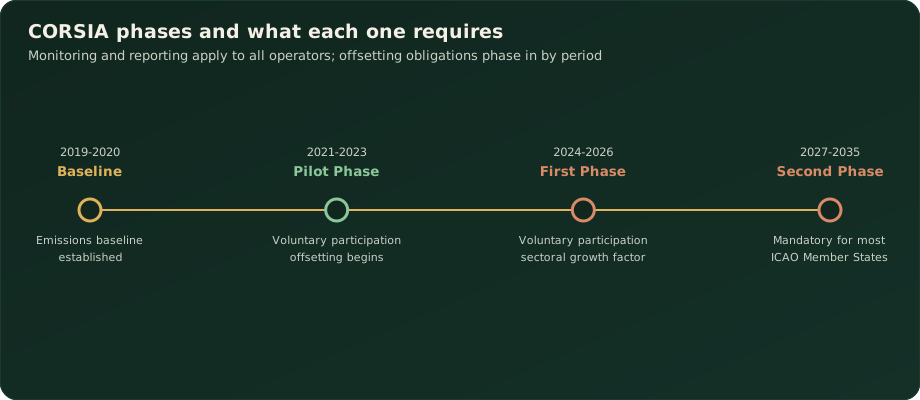
The Periods at a Glance
| Period | Years | Participation | Growth factor | What it means |
|---|---|---|---|---|
| Baseline | 2019 | — | — | Reference emissions level |
| MRV begins | 2019 onward | All in-scope operators | — | Monitor, report, verify |
| Pilot phase | 2021-2023 | Voluntary States | Sectoral only | Small obligations in practice |
| First phase | 2024-2026 | Voluntary States | Sectoral only | Obligations become material |
| Second phase | 2027-2035 | Mandatory for most States | Sectoral, then blended | Coverage and cost step up |
The Baseline: 2019
The baseline is the reference against which growth is measured. It was originally defined as the average of 2019 and 2020 emissions.
The 2020 traffic collapse made that average unusable — it would have set the reference far below any plausible activity level and inflated every future obligation. In 2020 the ICAO Council reset the baseline to 2019 emissions alone.
Monitoring, reporting and verification obligations began in 2019, independent of any offsetting requirement.
Pilot Phase: 2021 to 2023
Applied to operators from States that volunteered. Around eighty States participated at various points.
Two design features defined it:
- Sectoral growth factor only. Obligations were calculated from sector-wide growth applied to each operator's own emissions, not from individual growth.
- Route-pair coverage. Offsetting arose only where both origin and destination States participated.
In practice the obligations were very small. The 2021 sectoral growth factor was zero, because sector emissions that year remained below the 2019 baseline. Meaningful obligations only emerged as traffic recovered through 2022 and 2023.
The pilot phase tested the machinery — plans, reporting, verification, registry mechanics — under conditions far gentler than those now applying. Operators who treated it as a genuine dry run are in good shape. Those who treated it as paperwork face a steeper curve exactly as the numbers get large.
First Phase: 2024 to 2026
Same voluntary participation, same route-pair logic, same sectoral basis. What changed is scale.
With traffic above 2019 levels across much of the network, the sectoral growth factor is now materially positive and offsetting requirements are real numbers.
Three things matter operationally:
Compliance periods are three years, and that invites deferral
The 2024-2026 period is a single block. Operators must cancel sufficient units and report by the deadline following the period's end.
The flexibility is genuine. The temptation is to defer purchasing to the end, which is a bet that eligible supply will be available and affordably priced when the entire sector is buying simultaneously. Given the corresponding adjustment bottleneck constraining supply, it is a bet with poor odds.
Eligible supply is the binding constraint, not price alone
Analyses have consistently projected that the volume of units carrying host-State corresponding adjustments will lag demand. Availability, not merely cost, is a live risk — and contracts should say what happens if supply cannot be sourced.
Participation can shift under you
States have joined, and at least one has withdrawn. An operator's route coverage can change between planning and paying, without its own network changing at all.
Second Phase: 2027 to 2035
This is the structural change.
From 2027, participation becomes mandatory for States meeting defined aviation activity thresholds — broadly, States with a significant share of international aviation activity measured in revenue tonne kilometres.
Exemptions remain for:
- Least developed countries
- Small island developing States
- Landlocked developing countries
- States with very small international aviation activity
unless those States choose to volunteer.
Route-pair coverage expands substantially. Routes generating no obligation during the first phase, because one end was non-participating, begin to count.
The Individual Growth Factor Enters
From 2030 the calculation shifts weight from sectoral to individual growth:
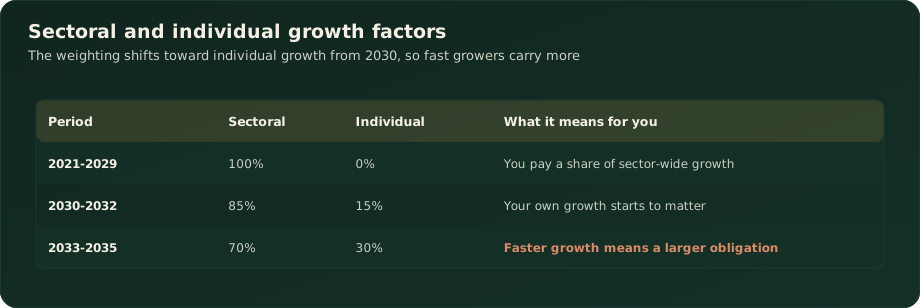
| Period | Sectoral weight | Individual weight |
|---|---|---|
| 2021-2029 | 100% | 0% |
| 2030-2032 | 85% | 15% |
| 2033-2035 | 70% | 30% |
A carrier expanding faster than the sector progressively carries more of its own burden. The intent is to remove the free ride a purely sectoral approach gives to fast growers.
For operators with aggressive fleet and network plans — and that includes much of the Indian market — this connects growth decisions directly to a future CORSIA cost. That connection belongs in the fleet planning model, not in a surprise later.
Dates That Actually Bind
Phase boundaries are the headline. These are the dates operators actually work to:
| Recurring deadline | What is due |
|---|---|
| Before the first reporting year | Emissions Monitoring Plan submitted and approved |
| Annually, following the reporting year | Verified Annual Emissions Report to the State |
| After ICAO publishes growth factors | Offsetting requirement becomes a firm figure |
| Following the close of each three-year period | Units cancelled and Cancellation Report filed |
Exact submission dates are set in national implementing law and vary by State. Check your authority's calendar rather than assuming a common date.
Planning Backwards From 2027
For operators
Model your second-phase obligation against your actual network, not a generic uplift. The change is entirely network-specific — a carrier flying predominantly to already-participating States sees little difference; one with heavy traffic to currently non-participating States can see the obligation multiply.
Have these in place before 2027: a monitoring plan producing reliable data without heroic manual effort, registry accounts opened and tested, a documented view on forward versus spot purchasing, and a model of route coverage under mandatory participation.
For project developers
Second-phase demand arrives on a known date, which makes it the clearest planning signal in this market.
Work backwards: a new project typically needs eighteen months to three years from concept to first issuance, and host-State authorisation is the least predictable element in that span. Developers targeting the demand ramp need to be resolving authorisation now, not when demand becomes visible — by then, supply that was ready will already be contracted.
See the seller pathway.
The Periodic Review
CORSIA includes a review mechanism. The ICAO Assembly periodically reviews implementation and can adjust the scheme's parameters.
Reviews have already produced the baseline change. Further adjustment to growth factor weighting, vintage windows and phase design is possible.
This is not a reason to discount the obligation. It is a reason to build flexibility into the plan — avoid over-committing to a single vintage, avoid assuming a fixed price path, and revisit the model when Council decisions land.
Where to Go Next
- Baseline and growth factors — the arithmetic behind the phases
- CORSIA scope and thresholds — what route-pair coverage means for you
- The requirement calculation — turning a phase into a number
- Supply and demand outlook — why timing matters
Current participation lists are published by ICAO and change — check rather than relying on a saved copy.
DSTechnoverse models second-phase exposure against actual route networks. Talk to our carbon markets team or apply as a CORSIA buyer or seller.
Need this applied to your position?
We assess operators’ obligations and developers’ eligibility pathways directly.