CORSIA Scope: Who Is In, Who Is Out, and Which Flights Count
The five tests that decide whether a flight generates a CORSIA offsetting obligation — international status, aircraft mass, the 10,000 tonne threshold, exempt flight types, and the covered route pair rule.
Whether CORSIA applies to you, and to which of your flights, is decided by five tests. All five must pass for a flight to generate an offsetting obligation. Monitoring and reporting obligations apply more broadly than offsetting does, which is the distinction most often missed.
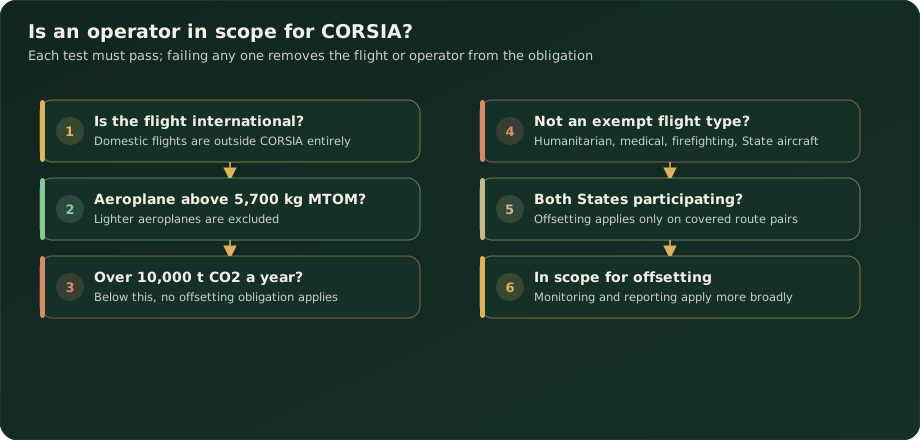
Test 1: Is the Flight International?
CORSIA covers international flights only — those departing from an aerodrome in one State and arriving in a different State.
Domestic flights are entirely outside the scheme. They may be covered by national policy, but not by CORSIA.
For a carrier with a large domestic network and a smaller international operation, this single test can remove most of total emissions from consideration immediately.
Test 2: Is the Aeroplane Above the Mass Threshold?
CORSIA applies to aeroplanes with a maximum certificated take-off mass (MTOM) above 5,700 kg.
Two points of precision:
- The scheme applies to aeroplanes. Helicopters and other rotorcraft are outside it.
- 5,700 kg is a low bar. It captures most business jets, not merely airline aircraft.
Test 3: Does the Operator Exceed 10,000 Tonnes of CO2?
An operator producing more than 10,000 tonnes of CO2 per year from international flights covered by the scheme is in scope for offsetting.
10,000 tonnes corresponds to roughly 3,165 tonnes of jet fuel, at the standard factor of 3.16 kg CO2 per kg of fuel. That is a smaller operation than most people assume — a handful of long-haul aircraft, or a modestly sized business aviation operation.
Do not assume you are below the threshold. Calculate it. Operators sitting near the line should establish which side they are on rather than inferring it from fleet size.
Test 4: Is the Flight Type Exempt?
Certain flights are excluded regardless of everything else:
| Exempt category | Notes |
|---|---|
| Humanitarian flights | Relief and aid operations |
| Medical flights | Including organ transport and air ambulance |
| Firefighting flights | Aerial firefighting operations |
| State aircraft | Military, customs and police services |
These exclusions are narrow and apply to the specific flight, not to the operator as a whole. An operator conducting both commercial and humanitarian flights excludes only the latter.
Test 5: Are Both States Participating?
This is the test that decides the size of the number, and it is the one that changes most.
An offsetting obligation arises only where both the origin State and the destination State are participating in CORSIA for that year. A flight from a participating State to a non-participating State generates no offsetting obligation.
That flight is still monitored and reported. It simply does not attract offsets.
Why route-pair coverage matters so much commercially
Two operators with identical emissions can face very different obligations depending on where they fly. A carrier operating predominantly between participating States is fully exposed; one with heavy traffic to non-participating States is not.
It also means an operator's obligation can move without its own operations changing at all, simply because a State joins or leaves the scheme. Coverage expands substantially from 2027 when second-phase participation becomes mandatory for States above defined aviation activity thresholds.
Modelling this against your actual network — rather than applying a generic percentage uplift — is the only way to get a usable forecast. See CORSIA phases and timeline.
Monitoring Scope vs Offsetting Scope
These two are different and conflating them produces both under-reporting and over-budgeting.
| Monitoring and reporting | Offsetting | |
|---|---|---|
| Applies to | All international flights of an in-scope operator | Only covered route pairs |
| Threshold | Above 10,000 t CO2 from international flights | Same operator threshold |
| Depends on State participation | No | Yes, both ends |
| Began | 2019 | Pilot phase, 2021 |
| Consequence of ignoring | Enforcement by the national authority | Unmet obligation plus enforcement |
The practical rule: report widely, offset narrowly. Your reporting boundary is larger than your offsetting boundary.
Which Legal Entity Is the Operator?
This sounds administrative and is not. Getting it wrong misallocates emissions between entities, and correcting it later is painful.
The operator for CORSIA purposes is the entity that operates the flight, generally identified by its Air Operator Certificate and its ICAO designator. Complications arise with:
Wet leases and ACMI arrangements
Where an aircraft is provided with crew, maintenance and insurance, the question is which party is operating the flight. The answer follows the operating certificate under which the flight is conducted, not the aircraft's ownership.
Code shares
The operating carrier reports the emissions, not the marketing carrier. A seat sold under one airline's code on another airline's metal belongs to the operator of the metal.
Group structures with multiple certificates
A group holding several Air Operator Certificates has several operators for CORSIA purposes, each with its own threshold test, monitoring plan and reporting obligation. Aggregating them at group level is incorrect.
Franchise and regional partner operations
Follow the operating certificate. The brand on the tail does not determine the reporting entity.
A Scope Determination Checklist
Work through these and document the answers — the reasoning will be tested at verification years later, quite possibly by someone who was not present when it was decided.
- Identify each legal entity holding an operating certificate in your group.
- For each entity, list all flights and classify them as domestic or international.
- Exclude aeroplanes at or below 5,700 kg MTOM, and all rotorcraft.
- Exclude humanitarian, medical, firefighting and State aircraft flights.
- Calculate annual CO2 from the remaining international flights, and test against 10,000 tonnes.
- For entities above the threshold, identify covered route pairs using the current participation list.
- Capture the participation list as at the date relied on — the published list changes, and a link is not evidence of what it said on the day.
- Model the same network against second-phase mandatory participation from 2027.
Where to Go Next
- How CORSIA works — the mechanism this scoping feeds
- CORSIA phases and timeline — how coverage changes
- The requirement calculation — turning scope into tonnes
- CORSIA MRV explained — what reporting requires
Participation lists and the current standards are published by ICAO. Indian operators deal with the DGCA as national authority — see CORSIA in India.
Unsure which side of a threshold you sit on? DSTechnoverse runs scope and threshold assessments as a bounded first engagement. Get in touch.
Need this applied to your position?
We assess operators’ obligations and developers’ eligibility pathways directly.