CORSIA MRV: Monitoring, Reporting and Verification Explained
The annual MRV cycle under ICAO Annex 16 Volume IV — what must be monitored, what the Annual Emissions Report contains, how verification works, and the independence and capacity constraints that catch operators out.
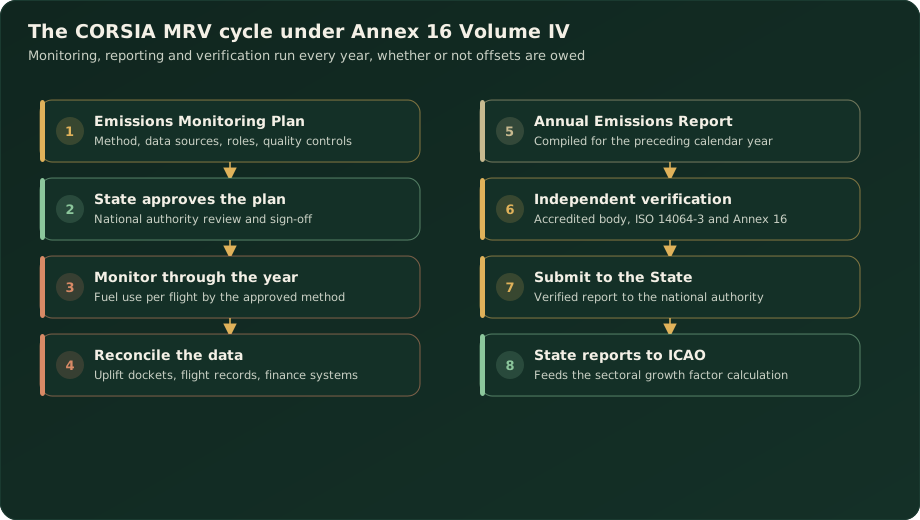
Monitoring, reporting and verification is the part of CORSIA that runs every single year, whether or not you owe a single tonne of offsets. It is also where the data comes from that determines everyone else's obligation.
Why MRV Applies Even Without Offsets
The sectoral growth factor is computed from the verified emissions of the whole covered sector. ICAO cannot produce it without the reports.
That is why an operator flying only to non-participating States — and therefore owing nothing — still monitors, reports and verifies. Their data is an input to the calculation that binds others.
This catches operators who reason from their own obligation to their own paperwork. The two have different scopes: report widely, offset narrowly.
The Legal Basis
MRV requirements sit in Annex 16, Volume IV to the Chicago Convention, implemented through national law. Supporting material sits in the ICAO Environmental Technical Manual, Volume IV.
The obligation attaches to operators producing more than 10,000 tonnes of CO2 per year from international flights using aeroplanes above 5,700 kg MTOM.
The Cycle, Step by Step
1. Emissions Monitoring Plan
Submitted to the national authority before monitoring begins, and approved by it. The plan defines method, data sources, systems, roles and quality controls.
Covered in full in the Emissions Monitoring Plan.
2. Monitor Through the Year
Fuel use tracked flight by flight and by aerodrome pair, using the approved method. Emissions derived from fuel mass at 3.16 kg CO2 per kg for Jet-A and Jet-A1.
3. Reconcile the Data
This is where the annual effort actually concentrates, and it is rarely what operators expect.
Fuel uplift dockets, flight operations records, aircraft systems and finance records disagree. Not through error, usually, but because they measure slightly different things at slightly different moments. Reconciling them into one defensible dataset — with documented rules for how discrepancies are resolved — is a data engineering problem before it is a carbon problem.
The rules must be written down. A verifier will ask why a particular discrepancy was resolved the way it was, and "that is what we have always done" is not an answer that survives.
4. Compile the Annual Emissions Report
For each calendar year, covering all international flights, with the in-scope subset identified.
The report typically includes:
- Operator identification and the applicable monitoring plan version
- Total fuel consumption and CO2, by aerodrome pair
- The split between covered and non-covered route pairs
- Any CORSIA Eligible Fuels claimed, with supporting certification
- Data gaps encountered and how they were filled
- Any changes to methods or systems during the year
5. Independent Verification
An accredited verification body verifies the report against Annex 16 Volume IV.
Independence — the constraint that surprises people
The body verifying your report cannot have advised on it. If a consultant wrote your monitoring plan, that firm cannot verify against it. If a body validated something, conflict rules may prevent it verifying the related performance.
This is ordinary assurance practice, but operators used to buying advice and assurance from one supplier find it disruptive. Plan for two suppliers from the outset.
Capacity — engage early or take who is left
Accredited bodies are limited in number and demand clusters in the same few months every year, because every operator has the same reporting calendar. Verifier availability is a genuine scheduling constraint, not a formality.
What verifiers actually test
Expect sampling of fuel records against source documents, examination of the reconciliation logic and its documented rules, testing of the flight list for completeness, review of how in-scope and out-of-scope flights were classified, treatment of data gaps and exceptions, and evidence supporting any fuels claim.
Anticipating these and having the evidence organised in advance is the difference between a smooth verification and an expensive one.
6. Submit to the National Authority
The verified report goes to the State authority — the DGCA for Indian operators.
7. The State Reports to ICAO
Aggregated data is passed to ICAO, feeding the sectoral growth factor.
Materiality and Data Gaps
No dataset is perfect. Two concepts govern how imperfection is handled.
Materiality defines how large a misstatement can be before it matters. Thresholds are set relative to reported emissions, with tighter thresholds for larger emitters.
Data gaps are inevitable — a missing docket, a system outage, a record that cannot be located. The monitoring plan must specify in advance how gaps will be filled, typically by a documented estimation procedure. Filling a gap by an undocumented ad hoc method, decided after the fact, is the version that attracts findings.
Record Retention
Records supporting the report must be retained and must survive staff turnover and system migration.
Retain at minimum: every version of the monitoring plan with its approval, the source fuel and flight data, the reconciliation logic and rules, the Annual Emissions Report as submitted, the verification statement and any findings log, evidence for fuels claims, and the authority's acknowledgements.
The test: could someone not involved reconstruct the reported figure from your files alone, three years from now, without contacting anyone who has left?
Common MRV Failures
| Failure | Why it happens | Cost |
|---|---|---|
| Method your data cannot support | Chosen on paper without testing | Discovered at verification; year cannot be redone |
| Manual reconciliation each year | No investment in the pipeline | Expensive, inconsistent between years |
| Late verifier engagement | Underestimating capacity constraints | Whoever is left, at whatever price |
| Undocumented discrepancy rules | Decisions made informally | Verification findings, re-work |
| Incomplete flight list | Classification logic not systematic | Material misstatement |
| Records lost to system migration | Retention not owned by anyone | Cannot defend the figure at audit |
| Assuming exemption from reporting | Confusing offsetting scope with reporting scope | Enforcement action |
Where to Go Next
- The Emissions Monitoring Plan — step 1 in detail
- Fuel monitoring methods compared — choosing correctly
- Baseline and growth factors — what your data feeds
- CORSIA scope and thresholds — reporting vs offsetting scope
Standards are published by ICAO.
DSTechnoverse comes to CORSIA from environmental data and analytics, which is exactly where MRV difficulty concentrates. Talk to our team about your monitoring and reconciliation.
Need this applied to your position?
We assess operators’ obligations and developers’ eligibility pathways directly.