CORSIA Governance: Who Decides What
The ICAO Assembly, Council, CAEP and Technical Advisory Body each control different parts of CORSIA, and national authorities enforce it. A map of which body sets which rule, and where to watch for change.
CORSIA is governed by several ICAO bodies with distinct remits, and implemented by national authorities. Knowing which body controls which parameter tells you where to watch when something is likely to change.
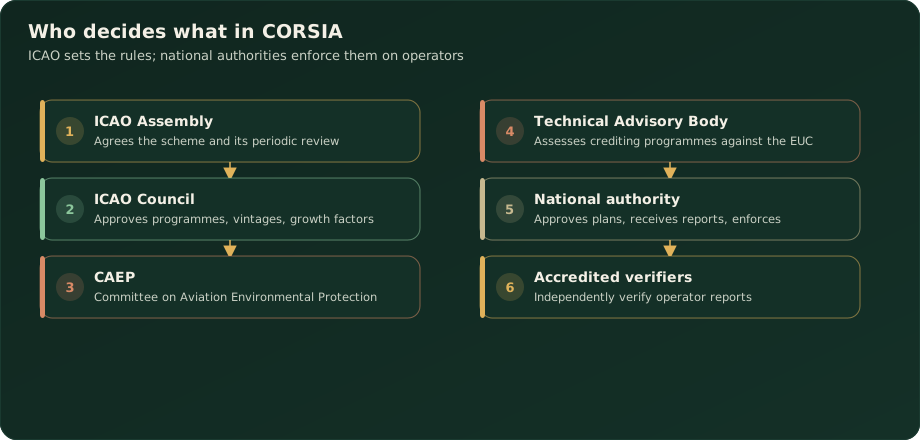
The Bodies
| Body | What it controls |
|---|---|
| ICAO Assembly | Adopts the scheme; conducts periodic review |
| ICAO Council | Approves crediting programmes, vintage windows, growth factors, State participation lists |
| CAEP | Develops technical standards and recommends to the Council |
| Technical Advisory Body (TAB) | Assesses crediting programmes against the Emissions Unit Criteria |
| National authorities | Approve monitoring plans, receive reports, enforce |
| Accredited verification bodies | Independently verify operator reports |
The ICAO Assembly
ICAO's sovereign body, meeting every three years, with all Member States represented.
The Assembly adopted CORSIA by Resolution A39-3 in 2016 and has revisited it at subsequent sessions. It conducts the periodic review of the scheme, which can change its fundamental design — participation rules, phase structure, and whether it continues beyond 2035.
This is the body to watch for structural change rather than parameter adjustment.
The ICAO Council
A 36-State governing body meeting continuously between Assemblies. In practice this is where most CORSIA decisions are actually taken.
The Council:
- Approves crediting programmes, on TAB recommendation
- Sets eligible vintage windows for each compliance period
- Publishes growth factors
- Adopts Standards and Recommended Practices into Annex 16, Volume IV
- Maintains the list of participating States
Why Council decisions matter commercially
Every parameter a buyer or developer depends on sits here.
The Council reset the baseline from a 2019-2020 average to 2019 alone. It has approved, conditioned and allowed programme approvals to lapse. It sets and has extended vintage windows.
A market participant who tracks only Assembly outcomes will miss almost everything that affects a transaction. Council decisions are the operative layer.
CAEP
The Committee on Aviation Environmental Protection is ICAO's technical committee on aviation environmental matters, with member and observer States and a range of observer organisations.
CAEP develops the technical detail — monitoring methodologies, sustainability criteria for CORSIA Eligible Fuels, and standards that go to the Council for adoption. It works through specialist working groups.
CAEP does not decide; it recommends. But because Council decisions typically follow CAEP work, CAEP's direction is a leading indicator.
The Technical Advisory Body
The TAB is a group of independent experts that assesses applications from crediting programmes against the Emissions Unit Criteria and recommends approval, conditional approval, or refusal to the Council.
It examines governance, methodology development processes, additionality requirements, quantification, permanence, validation and verification oversight, registry infrastructure, double-counting safeguards and social and environmental safeguards.
The TAB also conducts periodic reassessment. Approvals are not permanent, and have lapsed.
See approved crediting programmes.
National Authorities
ICAO cannot fine an airline. The obligation reaches operators through domestic law.
National authorities — the DGCA in India, the FAA in the United States, competent authorities across Europe — approve Emissions Monitoring Plans, receive Annual Emissions Reports, oversee verification, receive Emissions Unit Cancellation Reports, and enforce.
See national authorities and enforcement.
Accredited Verification Bodies
Independent third parties that verify operator reports. They are accredited under national accreditation arrangements against the applicable standards, and their independence from the party being verified is a hard requirement — a firm that advised on your monitoring plan cannot verify against it.
Who to Watch for What
| If you care about | Watch |
|---|---|
| Whether the scheme continues past 2035 | Assembly, periodic review |
| Whether your programme stays approved | Council decisions, TAB reassessment |
| Whether your vintage stays eligible | Council decisions |
| Your obligation size this year | Council growth factor publication |
| Whether a route becomes covered | Council participation list |
| Technical monitoring rules | CAEP work programme, then Annex 16 amendments |
| Whether your plan is approved | Your national authority |
| Whether your report passes | Your verification body |
A Note on Change
CORSIA is a scheme still under construction. Programme approvals change, vintage windows move, participation shifts, and second-phase details continue to be worked through.
Any advice presenting these as settled is either not following the scheme closely or is selling certainty that does not exist. Build flexibility into plans rather than assuming today's parameters hold to 2035 — the scheme's own history is the argument against that assumption.
Where to Go Next
- National authorities and enforcement — the implementing layer
- Approved crediting programmes — what the TAB does
- Official documents — where the rules are written
- Why CORSIA exists — how this governance came about
ICAO publishes decisions and documents at icao.int.
Need this applied to your position?
We assess operators’ obligations and developers’ eligibility pathways directly.