CORSIA Compliance Periods and Deadlines Explained
Why the three-year compliance period is shorter than it sounds, how obligations accumulate and settle, why there is no carry-forward, and the administrative tail that turns a comfortable deadline into a tight one.
CORSIA obligations are calculated annually and settled in three-year blocks. That sounds like generous flexibility. Worked through against the actual sequence of events, it is considerably tighter than it appears — and it lands at the same moment for every operator in the scheme.
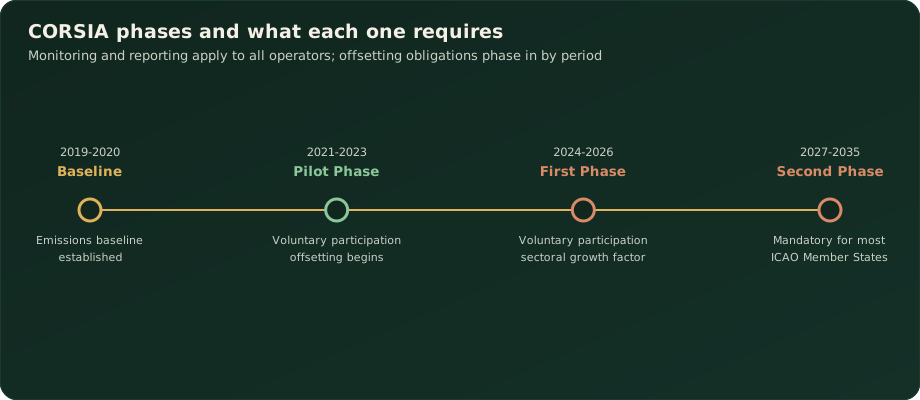
The Compliance Periods
| Period | Years | Notes |
|---|---|---|
| Pilot phase | 2021-2023 | Voluntary States; 2021 sectoral factor was zero |
| First phase | 2024-2026 | Voluntary States; obligations become material |
| Second phase, period 1 | 2027-2029 | Mandatory for most States |
| Second phase, period 2 | 2030-2032 | Individual growth factor at 15% weight |
| Second phase, period 3 | 2033-2035 | Individual growth factor at 30% weight |
Within a period, annual obligations accumulate. The total is discharged once, by cancelling units and filing a cancellation report after the period closes.
The Annual Rhythm Inside a Period
Even though settlement is per period, several things happen every year without exception:
| Every year | What |
|---|---|
| Throughout | Monitor fuel use under the approved plan |
| Following the year end | Compile the Annual Emissions Report |
| Following the year end | Independent verification by an accredited body |
| Following verification | Submit the verified report to the national authority |
| Once ICAO publishes | Growth factor confirmed; annual obligation becomes firm |
Monitoring and reporting never take a year off, regardless of whether offsets are owed.
Why Three Years Is Shorter Than It Sounds
Work backwards through the real sequence.
Emissions for a calendar year are reported and verified during the following spring. ICAO then aggregates the sector and publishes growth factors — which is the moment an operator's obligation for that year stops being an estimate. Obligations accumulate across the three years, and the total must be cancelled and reported by the deadline after the period closes.
The gap between "we now know what we owe" and "we must have cancelled" is therefore much shorter than three years.
And it is the same gap, at the same time, for every operator in the scheme. When the entire covered sector reaches its purchasing decision within one window, in a market where eligible supply is constrained by government authorisation decisions, thin supply does not stay affordable.
The Administrative Tail
Operators who plan to the cancellation deadline rather than backwards from it get caught by processing time they do not control.
Registry account opening — allow four to eight weeks
Accounts require entity documentation, beneficial ownership disclosure and know-your-customer verification. Some registries add legal review. An operator that agrees a purchase and then begins onboarding finds its own compliance blocking delivery.
Open accounts before you need them, and nominate more than one authorised representative so one person's absence cannot freeze your ability to transact.
Due diligence — one to three weeks per tranche
Verifying programme approval status, vintage, host-State authorisation, verification reports and registry chain of custody is evidence-gathering, not administration. It does not compress much with experience.
Transfers — days for intra-registry, longer between registries
Not all programmes support inter-registry transfer at all, and where they do it is slower and may need additional documentation.
Cancellation and reporting — allow weeks, not days
Registry systems have maintenance windows and load spikes, and the spikes fall near common deadlines because that is when everyone else is cancelling too. The cancellation report is then submitted, reviewed and acknowledged by the authority — and a query at that point becomes a missed deadline if there is no margin.
No Carry-Forward
Cancellation discharges the obligation for the period it is reported against. Surplus cancellation does not bank credit against a future period.
This makes accuracy in the requirement calculation directly financial. Over-cancelling by 5% on a 50,000 tonne obligation is 2,500 tonnes of eligible units bought at a premium and thrown away.
The corollary: under-cancelling leaves an unmet obligation, discovered at the worst possible moment, in a market where replacement supply may not be available at any sensible price.
The Deferral Question
Should you buy progressively through the period, or wait until the obligation is confirmed?
| Buy progressively | Wait until confirmed | |
|---|---|---|
| Price exposure | Averaged across the period | Concentrated in one window |
| Supply risk | Spread; multiple opportunities | All-or-nothing at the deadline |
| Volume certainty | Committing before the final number | Exact figure known |
| Competition | Buying when others are not | Buying alongside the whole sector |
| Cash timing | Spread across three years | Deferred to period end |
The genuine argument for waiting is volume certainty — you avoid over-buying against a forecast. The argument against is that everyone else is waiting too, for the same reason, in a supply-constrained market.
The pattern most operators settle on
Estimate the obligation annually. Acquire a conservative portion early — enough that you are not exposed to a supply squeeze, but comfortably below your central forecast so over-cancellation is unlikely. Reserve the final window for reconciliation rather than for the bulk of the purchase.
This trades a small amount of volume precision for a large reduction in supply and price risk, which is usually the right trade when the downside is an unmet legal obligation.
Deadlines Vary by State
CORSIA is implemented through national law. The obligation is uniform; the calendar is not.
Exact submission dates for monitoring plans, Annual Emissions Reports and cancellation reports are set by your national authority — the DGCA for Indian operators. Check your authority's published calendar rather than assuming a date common to all States.
A Backwards Planning Checklist
Working back from a cancellation deadline:
- Deadline — cancellation report filed and acknowledged
- Minus 2 weeks — cancellation executed in the registry
- Minus 4 weeks — units transferred into your account
- Minus 8 weeks — contracts executed, payment arranged
- Minus 11 weeks — due diligence complete on all tranches
- Minus 16 weeks — supply identified and shortlisted
- Minus 6 months — registry accounts open and tested
- Ongoing — obligation modelled annually, not awaited
Where to Go Next
- The requirement calculation — what accumulates
- CORSIA phases and timeline — the period boundaries
- Registries and cancellation — the final steps
- Supply and demand outlook — why deferral is risky
DSTechnoverse manages CORSIA compliance calendars for operators end to end. Get in touch.
Need this applied to your position?
We assess operators’ obligations and developers’ eligibility pathways directly.